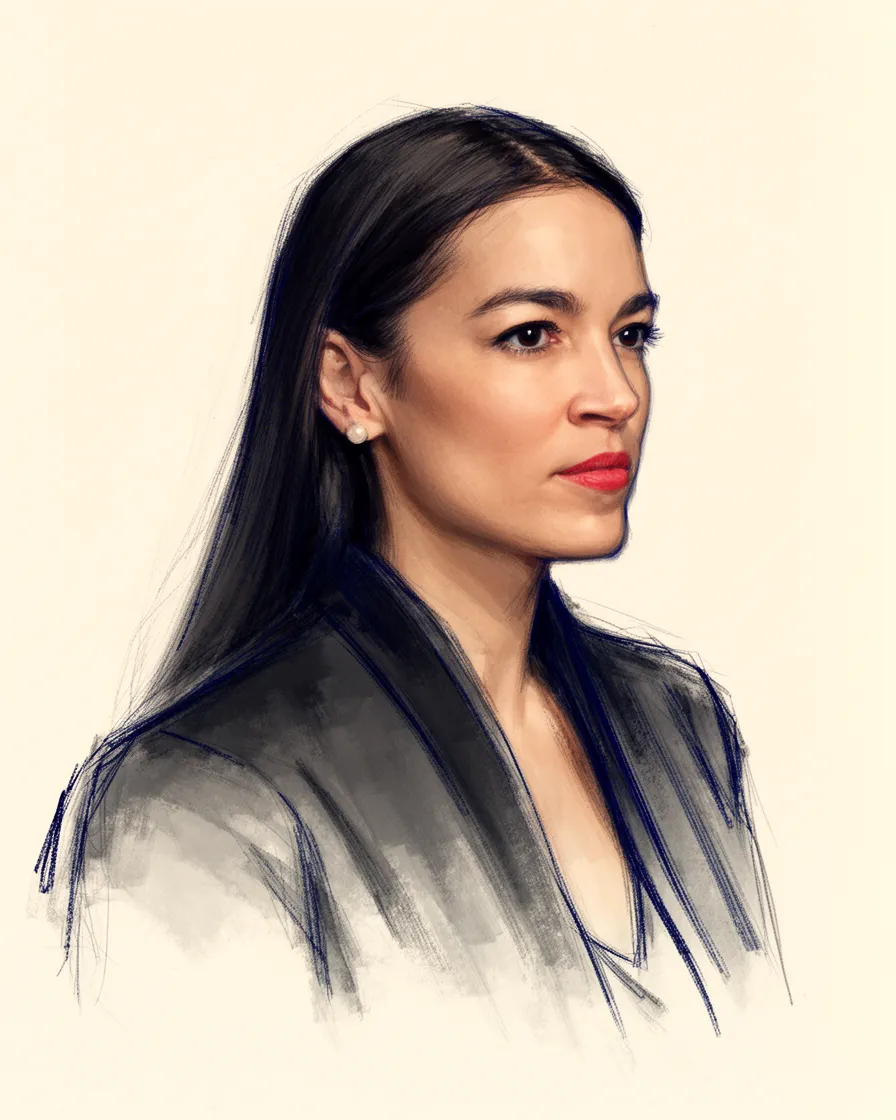
Alexandria Ocasio-Cortez on Israel
Alexandria Ocasio-Cortez (AOC) advocates for a two-state solution to the Israeli-Palestinian conflict and has consistently voiced opposition to the occupation of the West Bank.
Her public stance has often placed her on the progressive flank of the Democratic Party, leading her to vote against resolutions supporting Israel without qualification and to label the state as an apartheid state based on her assessment of its policies.
Following the October 7, 2023, attacks, she condemned the violence but has since been a vocal critic of Israel's subsequent assault on Gaza, characterizing the situation as a genocide and demanding an end to offensive U.S. military aid.
Her position includes a distinction between offensive and defensive weaponry, as seen in her evolving votes regarding funding for the Iron Dome system, which has drawn criticism from some on the political left.
Context
As a progressive leader in the Democratic Party, Alexandria Ocasio-Cortez's foreign policy views, particularly regarding Israel and Palestine, position her significantly to the left of many party leaders. Her consistent advocacy on this issue reflects her broader platform prioritizing human rights and international law.
Her position requires careful navigation between supporting a long-standing U.S. ally and expressing deep concern over its military actions and the conditions of Palestinians, especially given her electoral base in New York City, which has a large Jewish constituency.
Timeline
- Ocasio-Cortez voted against a resolution condemning the Global Boycott, Divestment, and Sanctions (BDS) Movement.
- She was one of nine progressive Democrats to vote against a resolution asserting that Israel is not a racist or apartheid state.
- She stated that "Apartheid states aren't democracies" in reference to Israel.
- Ocasio-Cortez abruptly changed her vote from 'no' to 'present' on a bill providing funding for the Iron Dome defense system.
- She opposed proposed funding cuts to the United Nations Relief and Works Agency for Palestine Refugees in the Near East (UNRWA).
- She boycotted Israeli Prime Minister Benjamin Netanyahu's speech to Congress, calling him a war criminal.
- Ocasio-Cortez condemned the October 7 attacks but has called Israel's subsequent military campaign in Gaza a genocide.
- She cosponsored the "Block the ("Block the Bombs Act")", which aims to halt U.S. provision of offensive weapons to Israel.
Actions Taken
- Voting_recordVoted against a resolution condemning the Global Boycott, Divestment, and Sanctions (BDS) Movement.
- Voting_recordVoted against a resolution stating that 'the State of Israel is not a racist or apartheid state'.
- Voting_recordChanged vote to 'present' on a bill funding the Iron Dome in September 2021, and voted against an amendment to cut $500 million in Iron Dome funding in July 2025.
- Protest_actionBoycotted Prime Minister Benjamin Netanyahu's 2024 speech to Congress.
- LegislationCosponsored the "Block the Bombs Act" to stop the U.S. from providing Israel with multiple offensive weapons.
- Official_statementCalled for the Biden administration to investigate weapons shipments and provide heavier sanctions in response to the West Bank occupation.
Key Quotes
Apartheid states aren't democracies.
The horrifying attacks against innocent civilians in Israel by Hamas.
Israel's assault on Gaza and the famine there constitutes a genocide.
Criticism
Ocasio-Cortez faced significant criticism from the left for her votes related to funding the Iron Dome in September 2021 and July 2025.
The DSA withdrew its endorsement of Ocasio-Cortez in 2024, citing concerns that her positions on Palestine had become weaker and specifically pointing to her support for a resolution characterizing denial of Israel's right to exist as antisemitism.
Sources5
Alexandria Ocasio-Cortez on Israel-Palestine
* This is not an exhaustive list of sources.