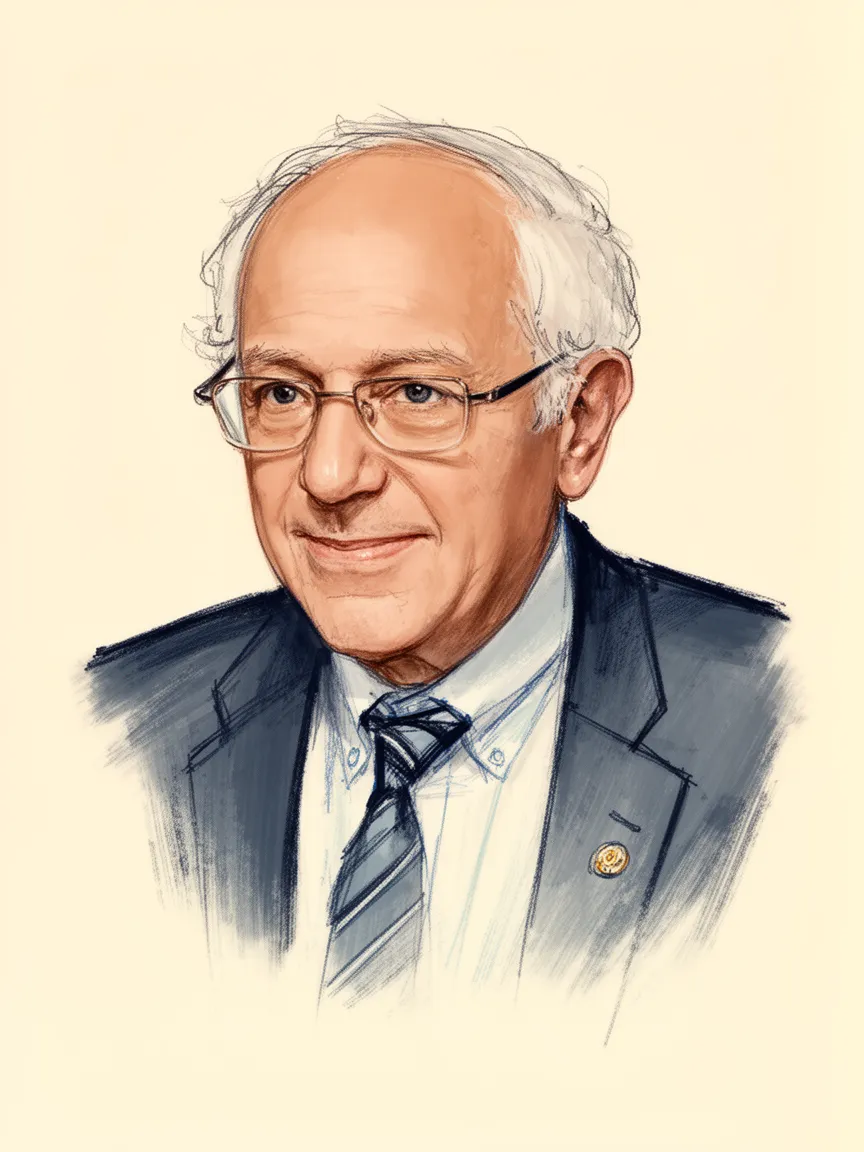
Bernie Sanders on Corporate Greed
Bernie Sanders views corporate greed as a central driver of America's rising income and wealth inequality and a corrupting influence on the political process. He argues that corporations and the wealthy elite actively work against the interests of working families, leading to the decline of the middle class and social ills. Sanders contends that the current economic system, which he sometimes terms "uber-capitalism," unfairly benefits a tiny fraction of the population.
Sanders’s core belief is that corporations must be held accountable to the public good rather than solely to maximizing shareholder profits. He has consistently pushed for policies aimed at shifting economic power back to workers and away from corporate CEOs and billionaires. His focus is on structural reforms to challenge what he calls a "right-wing oligarchy" entrenched in Washington and on Wall Street.
Throughout his political career, Sanders has taken concrete legislative and rhetorical actions to confront this perceived corporate excess. His opposition spans financial regulation, trade deals, and wealth concentration, framing the fight against corporate greed as a fundamental class struggle for a fair economy.
Context
Sanders's opposition to corporate excess is foundational to his democratic socialist ideology and his identity as a leader of the progressive movement. He frequently contrasts the accumulation of extreme wealth by a few with the struggles of the working class.
His critique often targets Wall Street and large financial institutions, exemplified by his long-standing efforts to reform the Federal Reserve and restore banking regulations like Glass-Steagall.
Actions Taken
- Legislative FilibusterDelivered an 8-hour and 34-minute speech filibustering the Tax Relief, Unemployment Insurance Reauthorization, and Job Creation Act of 2010, arguing it favored the wealthiest Americans.
- LegislationIntroduced the Stop Bad Employers by Zeroing Out Subsidies (Stop BEZOS) Act, which would require large corporations to cover the cost of their employees' food stamps and Medicaid benefits.
- Voting RecordVoted against the Troubled Asset Relief Program (TARP) as a Senator, expressing concern over aid to banks in free-fall.
- AmendmentProposed an amendment to the United States Innovation and Competition Act to block funded companies from outsourcing jobs or forbidding unionization, though it was voted down.
Key Quotes
I don't believe that the men and women who defended American democracy fought to create a situation where billionaires own the political process.
This is a budget for the billionaire class, for Wall Street, for corporate CEOs, and for the wealthiest people in this country... nothing less than a massive transfer of wealth from working families, the elderly, children, the sick and the poor to the top 1%.
We must end global oligarchy... we need, in the United States and throughout the world, a tax system which is fair, progressive and transparent.
Sources5
- The Speech: A Historic Filibuster on Corporate Greed and the Decline of Our Middle Class
- Bernie Sanders Opposed Trump's 2018 Budget, Calling It a 'Massive Transfer of Wealth'
- Sanders Statement on Paradise Papers Report
- Bernie Sanders introduced the Stop Bad Employers by Zeroing Out Subsidies (Stop BEZOS) Act
- Sanders on Economic Philosophy and Corporate Responsibility
* This is not an exhaustive list of sources.