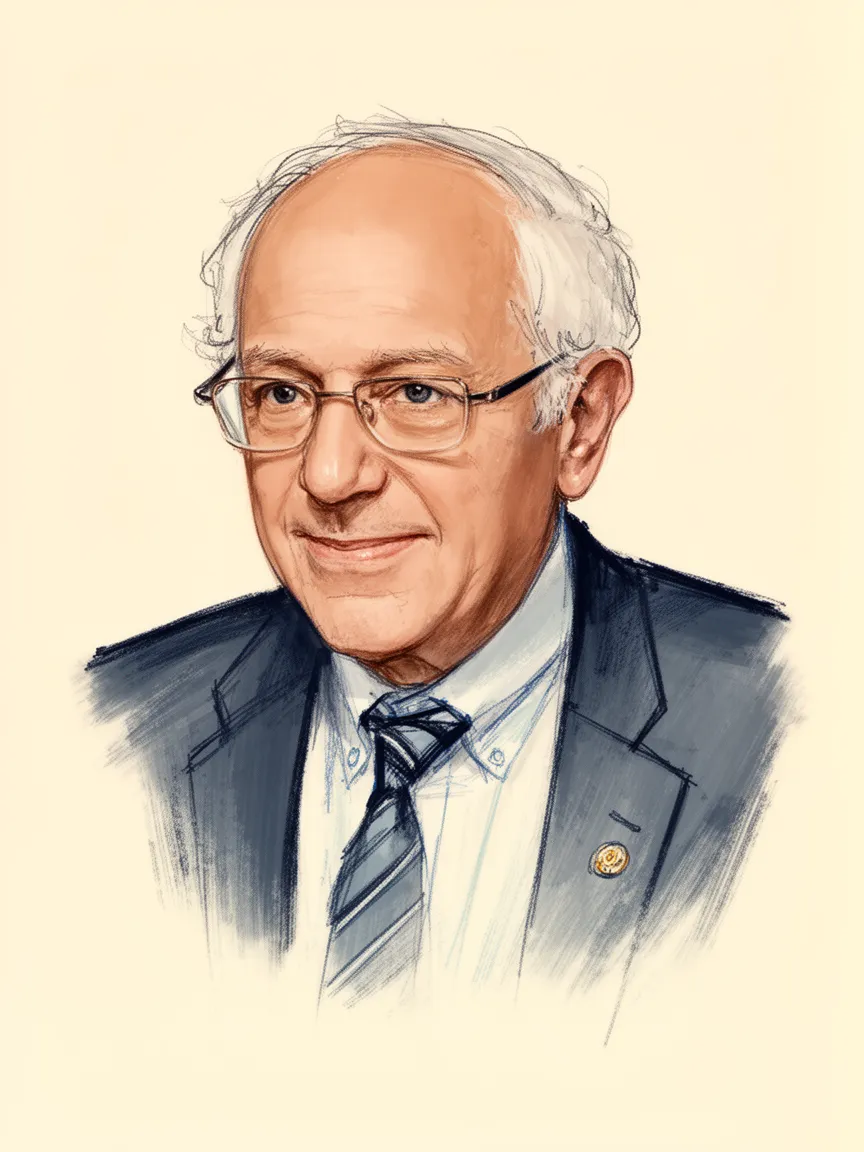
Bernie Sanders on Foreign Policy
Bernie Sanders maintains that US foreign policy should shift focus from military intervention to diplomacy and international collaboration, viewing climate change as the greatest national security threat. He supports significant reductions in military spending and advocates for greater emphasis on labor rights and environmental concerns when negotiating international trade agreements.
Throughout his career, Sanders has been a consistent critic of US military overreach, notably opposing the 2003 invasion of Iraq and US involvement in the war in Yemen. He has also expressed a desire to align US foreign policy with international agreements, such as the Paris Agreement and the Iran nuclear deal framework.
On specific conflicts, Sanders supports Palestinian rights while acknowledging Israel's right to exist, often introducing resolutions to block arms sales to Israel during conflicts. He has also been critical of specific actions by administrations, such as President Trump's drone assassination of Iranian General Qasem Soleimani and recognizing Jerusalem as Israel's capital.
Context
Bernie Sanders's foreign policy views are rooted in his long-standing progressive and anti-interventionist stance, which contrasts with what he often terms the consensus of the Washington establishment. As a member of Congress, he consistently voted against military authorizations, particularly those related to the Iraq War.
His current role as Senior United States Senator from Vermont allows him to use his platform and committee assignments to push for policy changes, such as his efforts regarding the war in Yemen and arms sales to Israel. His critiques often link international actions to domestic concerns, such as military spending diverting funds from social programs.
Timeline
- Sanders consistently criticized US foreign policy in Latin America, including opposing CIA funding for the Nicaraguan Contras.
- He voted against the resolution authorizing the use of military force against Iraq.
- Sanders voted in favor of the Authorization for Use of Military Force Against Terrorists, which provided the basis for post-9/11 military actions.
- Sanders voted against the resolution authorizing the use of force that led to the invasion of Iraq.
- Sanders outlined a foreign policy favoring greater international collaboration, adherence to agreements like the Paris Agreement, and restraint in US military power.
- He co-sponsored a bill using the War Powers Resolution to force an end to US support for the Saudi-led intervention in Yemen.
Actions Taken
- Voting RecordVoted against the resolution authorizing the use of force against Iraq.
- Voting RecordVoted against the resolution authorizing the use of force against Iraq in 2002, and opposed the 2003 invasion.
- Voting RecordVoted for the 2001 Authorization for Use of Military Force Against Terrorists.
- LegislationIntroduced a bill to withdraw normal trade relations status from China, citing job losses.
- LegislationSponsored a bill with bipartisan support to invoke the War Powers Resolution to end US support for the Saudi-led military intervention in Yemen.
- LegislationIntroduced several Joint Resolutions of Disapproval to block arms sales to Israel during the Gaza war.
- SpeechAddressed the Vatican on economic and environmental issues, meeting briefly with Pope Francis.
Key Quotes
We gotta be tough, not stupid
It would dramatically undermine the prospects for an Israeli–Palestinian peace agreement, and severely, perhaps irreparably, damage the United States' ability to broker that peace.
US military power must always be a last resort.
Criticism
Vetoed Sanders's Yemen resolution in 2019, calling it an attempt to weaken his constitutional authorities.
Sanders has criticized past administrations for supporting 'murderous regimes' during the Cold War and continuing an overly interventionist foreign policy.
Sources5
* This is not an exhaustive list of sources.