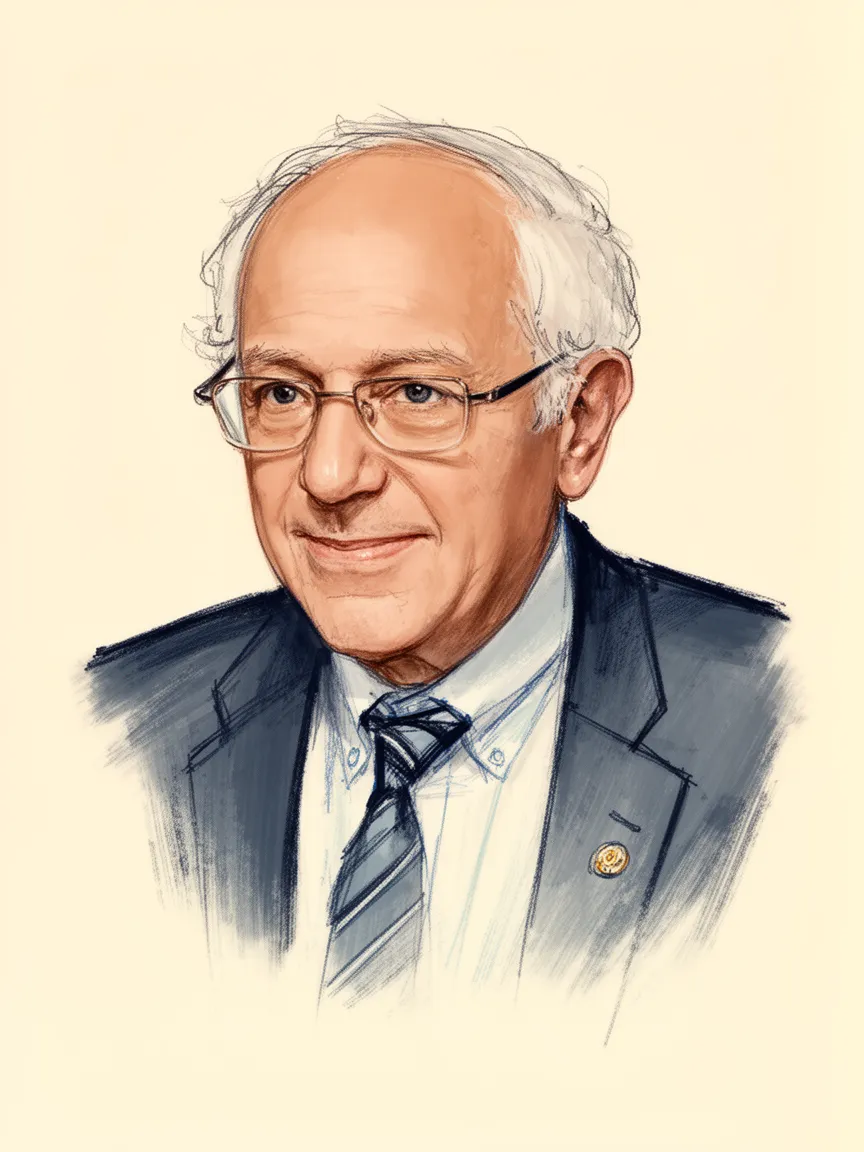
Bernie Sanders on Income Inequality
Bernie Sanders considers high income and wealth inequality a central moral and economic crisis in the United States, arguing that the current system is rigged to benefit billionaires and Wall Street at the expense of working families.
He contends that this concentration of wealth has led to profound social ills, including declining life expectancy, and he links it directly to the disproportionate influence of the wealthy class on the political process.
Sanders consistently proposes a series of progressive policy shifts, such as raising the minimum wage, expanding labor rights, and enacting a more progressive tax system, as necessary remedies to fundamentally overhaul this structure and rebuild the middle class.
Context
Bernie Sanders's focus on income inequality is deeply rooted in his self-identification as a democratic socialist, which informs his economic platform.
He views the current economic structure, which he critiques as neoliberal capitalism, as the direct cause of widening gaps between the rich and the poor.
This focus is a core element of the progressive movement he leads, driving his proposals for systemic reform across taxation, labor, and corporate governance.
Timeline
- Early political proposals included ideas that suggested workplace democracy and worker control over major industries, prefiguring later critiques of wealth concentration.
- Delivered an 8-hour filibuster against a bill extending Bush-era tax rates, arguing the legislation disproportionately favored the wealthiest Americans.
- His presidential campaign centered on the idea that billionaires own the political process, mobilizing small-dollar donors against large corporate and financial industry contributions.
Actions Taken
- LegislationIntroduced a bill to raise the minimum wage for federal contract workers to $15 an hour.
- LegislationIntroduced the Workplace Democracy Act, aimed at making it easier for workers to unionize and banning certain anti-union tactics, explicitly stating this is to reduce income and wealth inequality.
- LegislationPartnered to introduce the Stop BEZOS Act, which would require large corporations to cover the cost of food stamps and Medicaid benefits used by their employees, thus shifting the burden off taxpayers.
- Political StanceStated opposition to the 2018 United States federal budget proposed by the Trump administration, calling it a massive transfer of wealth to the top 1%.
- Political StatementCalled for an end to global oligarchy and for a fair, progressive, and transparent tax system following revelations about offshore tax avoidance.
Key Quotes
If we are serious about reducing income and wealth inequality and rebuilding the middle class, we have got to substantially increase the number of union jobs in this country.
This is a budget for the billionaire class, for Wall Street, for corporate CEOs, and for the wealthiest people in this country... nothing less than a massive transfer of wealth from working families, the elderly, children, the sick and the poor to the top 1%.
we must end global oligarchy and we need, in the United States and throughout the world, a tax system which is fair, progressive and transparent.
Sources3
- Economic issues - Bernie Sanders Political Positions
- 2016 presidential campaign - Bernie Sanders Biography
- U.S. Senate (2007–present) - Legislation
* This is not an exhaustive list of sources.