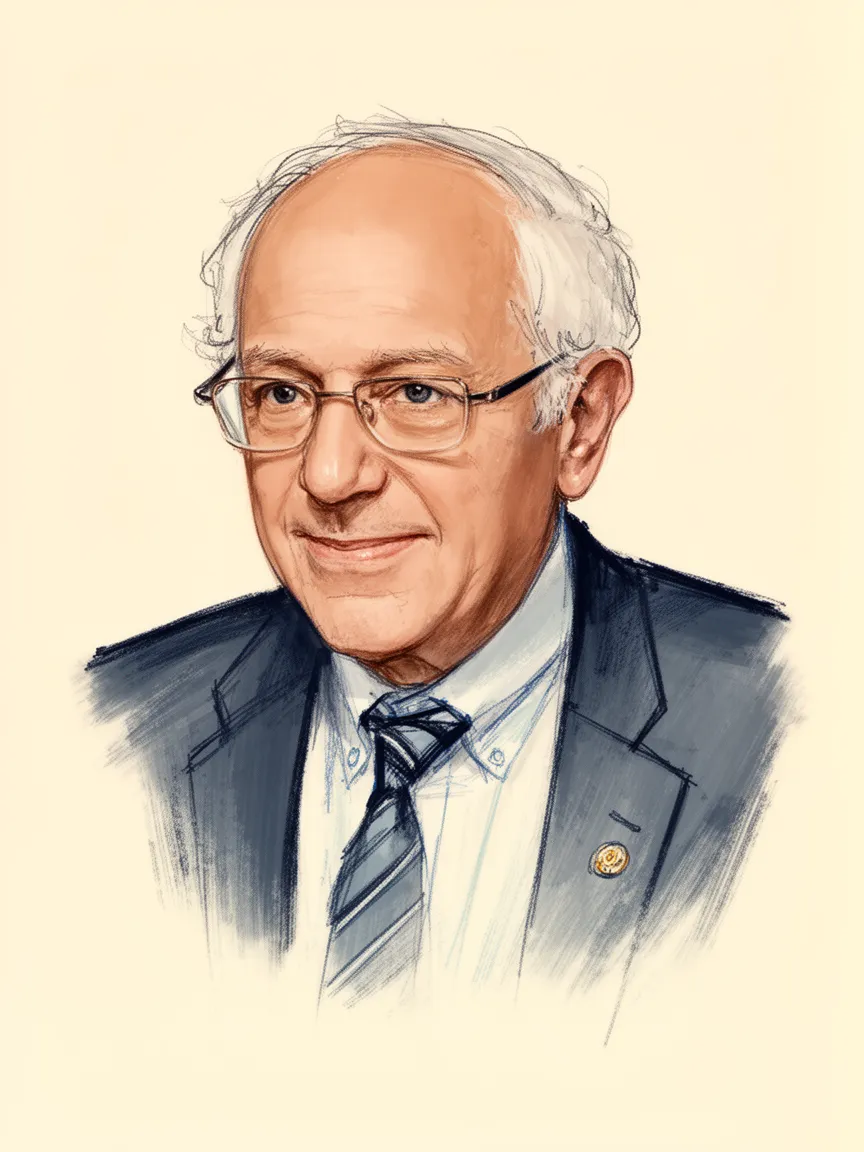
Bernie Sanders on Socialism
Bernie Sanders explicitly identifies as a democratic socialist, a label he has used consistently throughout his political career, including during his presidential campaigns.
He clarifies that his vision of democratic socialism does not equate to state control over all businesses, stating, "I don't believe government should take over the grocery store down the street or own the means of production." Instead, his focus is on achieving a decent standard of living for the working and middle classes through robust public services and economic regulations.
Sanders's political proposals often align with social democratic principles, such as universal healthcare (Medicare for All), tuition-free tertiary education, and enhanced worker control via unions and cooperatives. This approach has been characterized by some commentators as a blend of socialist and social democratic aims, often referred to as class struggle social democracy.
Context
Sanders's self-identification as a democratic socialist is central to his political identity and his framing of economic issues, setting him apart from the mainstream of the Democratic Party. This ideological grounding explains his consistent opposition to neoliberal capitalism and his advocacy for policies seen as structural overhauls of the current economic system.
His political evolution shows early affiliations with socialist organizations like the Young People's Socialist League and running on the Liberty Union Party ticket, providing a historical context for his current platform. As a senator and presidential candidate, he has championed the idea that his platform represents a necessary shift away from policies favoring the wealthy.
Actions Taken
- Political Caucus FormationCo-founded the Congressional Progressive Caucus in the House of Representatives.
- LegislationIntroduced the Medicare for All bill, a single-payer healthcare plan.
- LegislationIntroduced the Workplace Democracy Act to expand labor rights and union formation.
- Policy ProposalProposed legislation to require corporations to give workers equity stakes and grant workers 45% of board seats for large companies.
Key Quotes
I don't believe government should take over the grocery store down the street or own the means of production, but I do believe that the middle class and the working families who produce the wealth of America deserve a decent standard of living and that their incomes should go up, not down.
Democracy means public ownership of the major means of production, it means decentralization, it means involving people in their work. Rather than having bosses and workers it means having democratic control over the factories and shops to as great a degree as you can.
We must end global oligarchy and we need, in the United States and throughout the world, a tax system which is fair, progressive and transparent.
Comparison
Sanders's platform is often compared to the Nordic Model, which he explicitly praises, though he emphasizes his focus is on class conflict and structural change rather than just adopting existing social safety nets. His earlier political history involved running on platforms associated with the Liberty Union Party and the Socialist Workers Party, marking a shift from third-party candidacies to caucusing with and seeking the nomination of the mainstream Democratic Party.
Sources5
- Defining what "democratic socialism" means to him, Sanders said: "I don't believe government should take over the grocery store down the street..."
- Sanders credits his brother with introducing him to many of his ideas.
- Sanders's views on workplace democracy and public ownership in 1987.
- Sanders on ending oligarchy and tax fairness after 2017 revelations.
- Sanders partnered with Ro Khanna to introduce the Stop Bad Employers by Zeroing Out Subsidies (Stop BEZOS) Act.
* This is not an exhaustive list of sources.