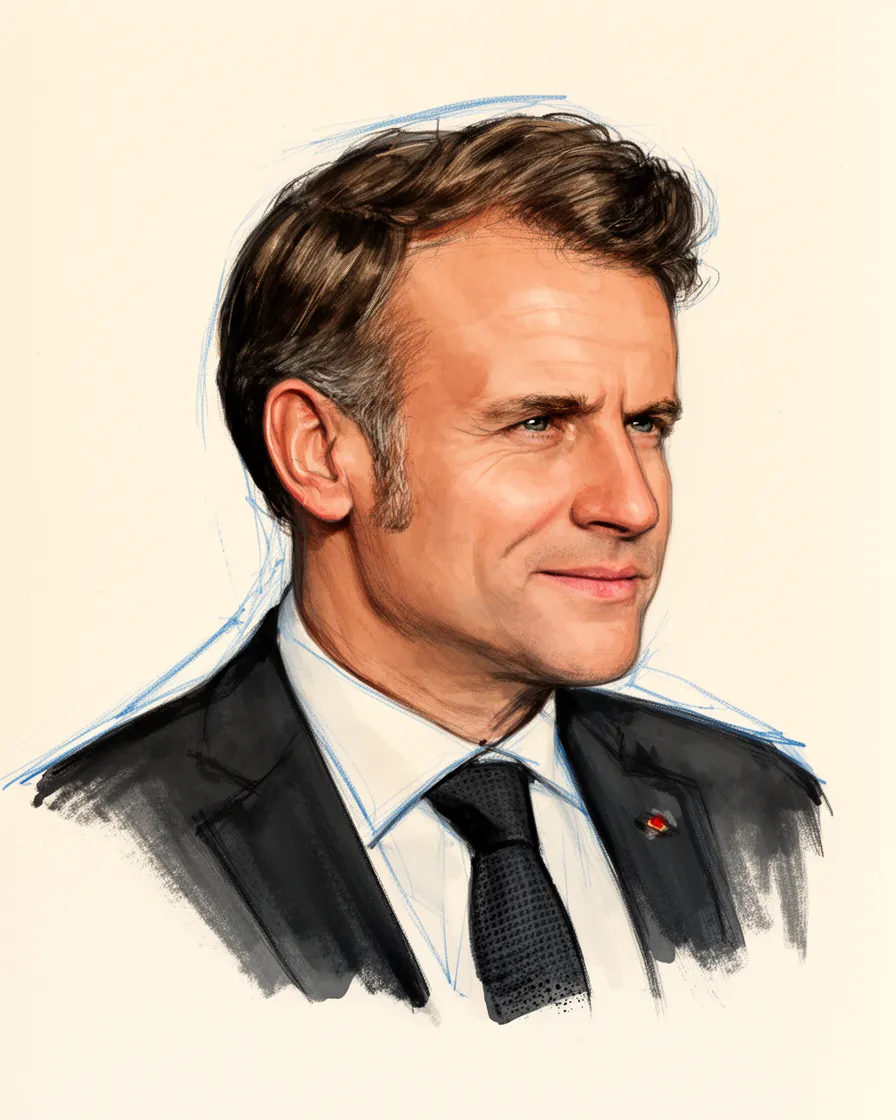
Emmanuel Macron on European Union (EU)
Emmanuel Macron views the European Union (EU) as essential for France and Europe's future, championing its reform to achieve greater sovereignty and geopolitical weight. From his early political career, Macron has promoted a vision of a stronger, more integrated Europe capable of acting independently on the world stage.
Macron's focus has been on practical steps toward this deeper integration, emphasizing areas like defense, economy, and technology to make the EU a genuine third superpower. He stresses that reliance on external powers, particularly the US, is not sustainable for long-term European interests.
This commitment to a reformed EU has been a constant throughout his presidency, underpinning his foreign policy initiatives and calls for European unity in the face of global challenges. His proposals often involve concrete mechanisms such as a larger EU budget and integrated capital markets.
Context
As President of France, Emmanuel Macron holds a central role in shaping the EU's direction, as France is one of the two largest member states, alongside Germany. His mandate gives him significant leverage to push for reformist and integrationist policies within the European Council.
Macron's position is informed by his background as a former Minister of Economics who was branded pro-EU and liberal, contrasting with more eurosceptic elements within French politics. His pursuit of a unified European response to global issues like defense and trade defines his European policy.
Actions Taken
- DiplomacyAgreed with German Chancellor Angela Merkel to draw up a "common road map" for Europe, indicating openness to Treaty changes.
- Policy ProposalPresented a 10-year vision policy to strengthen the EU at the Munich Security Conference, advocating for a larger budget, integrated capital markets, and an effective defense policy.
- Bilateral TreatySigned the Quirinal Treaty with Italian Prime Minister Mario Draghi to promote convergence and coordination of French and Italian positions on European and foreign policies, security, and defense.
- Foreign Policy SpeechCalled for Europe to reduce its dependence on the United States and avoid being drawn into U.S.-China confrontation, emphasizing strategic autonomy.
- Crisis Response SummitConvened a special meeting in Paris under the Weimar+ framework to coordinate European responses, characterizing Russia as an "existential threat" to Europe.
Key Quotes
Reliance on NATO and especially the US and the UK was not good for Europe, and a dialogue must be established with Russia.
Russia fully belongs within a Europe of values.
Europe could become a "third superpower".
Comparison
- Contrast with some domestic rivals: Macron's centrist, pro-European stance contrasts sharply with the more nationalist and eurosceptic positions frequently held by rivals like Marine Le Pen.
- Franco-German engine: Macron has consistently sought to renew the traditional Franco-German partnership as the main engine for EU integration, seen in early coordination with Angela Merkel and later with Olaf Scholz.
Sources3
Macron's Vision for a Sovereign Europe
* This is not an exhaustive list of sources.