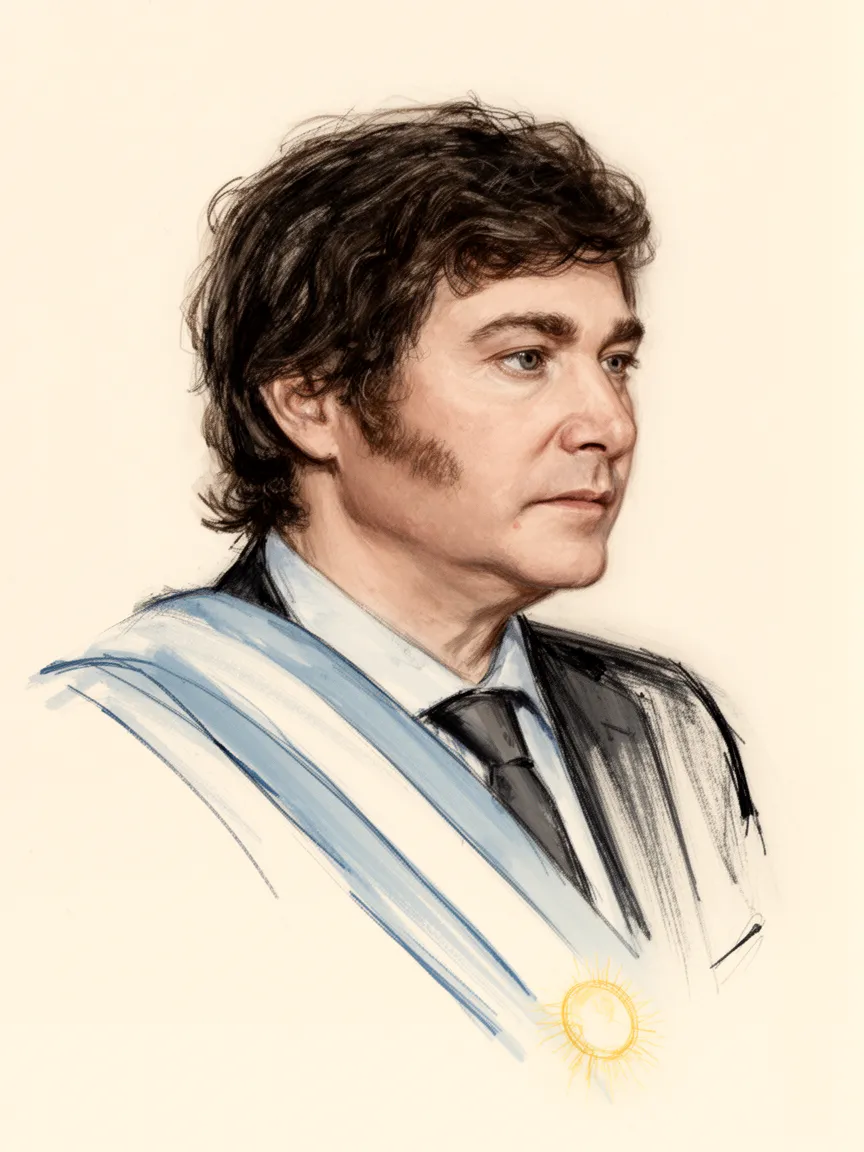
Javier Milei on Inflation
Javier Milei identifies inflation as the most critical issue in contemporary Argentine politics, viewing it as a consistent symptom of decades of economic mismanagement and placing the blame largely on the Peronist establishment.
His primary objective as President has been to stop the accelerating inflation through aggressive anti-inflationary economic policies, primarily focusing on the first and second years of his term to diminish its impact and curb the political influence of Peronism.
Milei's prescribed remedy is a comprehensive shock adjustment involving deep austerity and deregulation, asserting that "There is no alternative to a shock adjustment" because "There is no money."
Context
Inflation was the central issue that propelled Javier Milei to the presidency in the 2023 general election, with the annual rate spiraling past 100% and reaching 300% in May 2024 during his early tenure.
Milei's fundamental economic philosophy, rooted in the Austrian School of Economics, frames inflation as a monetary phenomenon, specifically the result of the government financing itself through an 'inflation tax' by printing money.
This conviction underpins his most radical proposals, such as the complete elimination of the Central Bank of Argentina, which he views as the ultimate source of the inflationary cycle.
Timeline
- Milei praised Domingo Cavallo for ending the 1989 hyperinflation and initiating state reforms, suggesting a model for tackling current monetary issues.
- Milei's poll numbers rose significantly as annual inflation surpassed 100 percent, highlighting inflation as a central campaign issue.
- Upon taking office, annual inflation stood at 254.2%, prompting Milei to immediately warn of an economic shock therapy to address financial woes.
- Annual inflation reached a peak of 300% under his administration before monthly inflation began to slow as austerity measures continued.
- Monthly inflation hit a 5-year low of 1.5%, with the annual rate decelerating to 39.4%, indicating success in the anti-inflationary push.
Actions Taken
- Austerity and Fiscal ReformImplemented 'shock therapy' involving drastic spending cuts, downsizing the government structure by laying off approximately 52,000 federal employees, and reducing the salaries of high-ranking officials to achieve a fiscal surplus.
- DeregulationRepealed rent controls, which led to a 190% increase in rental unit supply and a 40% decline in the real price of rental properties when adjusted for inflation in the initial months.
- LegislationPushed for and passed a tax and 'omnibus' bill, albeit watered down, aiming to deregulate and reform various sectors to support the fiscal adjustment.
Comparison
- Predecessor (Alberto Fernández/Sergio Massa): Milei directly attributes the 'ongoing Argentine monetary crisis' and the high inflation to the economic approach of the incumbent Peronist administrations that preceded him.
- Ideological Predecessor (Carlos Menem): Milei admires Menem's policies, which included dollarization, suggesting an ideological lineage for his own drastic approach to stabilizing the currency and curbing inflation.
Sources5
- Inflation was the foremost largest issue dominating contemporary Argentine politics...
- Milei warned of an economic shock, described as shock therapy in monetary terms...
- "There is no alternative to a shock adjustment", Milei said during his inauguration. "There is no money."
- Annual inflation stood at 254.2% in the first month of Milei's term, and reached a peak of 300% in May 2024.
- Milei celebrated the monetary policies of former British prime minister Margaret Thatcher and called her "a great leader".
* This is not an exhaustive list of sources.