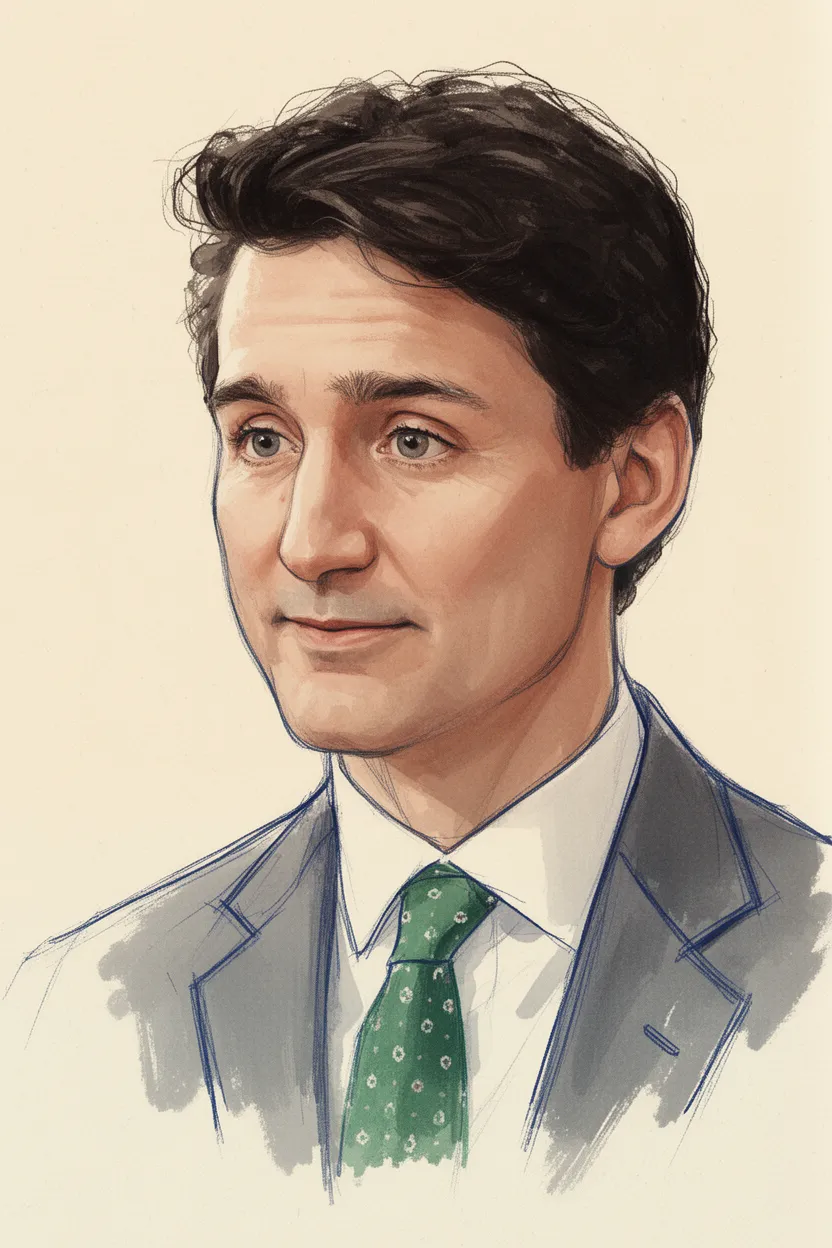
Justin Trudeau on Climate Change
Justin Trudeau viewed climate change as the greatest long-term threat the global community faces, but also as a significant economic opportunity through bold climate action.
His government established a national carbon pricing policy as a main tool to meet emission reduction targets and committed Canada to achieving net-zero emissions by 2050. They also introduced significant legislation like the Net Zero Emissions Accountability Act to legally bind future governments to multi-year targets.
Despite these commitments, Trudeau faced criticism for perceived policy incoherence, such as purchasing the Trans Mountain Pipeline shortly after declaring a climate emergency. Nevertheless, his tenure saw a reduction in Canada's emissions, though they remained off-track from the enhanced 2030 targets.
Context
Justin Trudeau made climate change a central pillar of his government's agenda upon taking office in 2015, marking a distinct shift from the preceding administration. His actions included signing the Paris Agreement and introducing new, legally binding frameworks for emissions reductions.
His government's approach involved a combination of putting a rising price on pollution (the carbon tax) and investing in clean technology, while also dealing with the politically sensitive reality of Canada's major oil and gas industry. This duality—pushing for climate action while supporting fossil fuel infrastructure—often defined the discourse surrounding his environmental record.
Actions Taken
- International CommitmentSigned the Paris Agreement on climate change, a key foreign policy action upon assuming office.
- Emissions Target UpdateAnnounced an enhancement to the Nationally Determined Contribution (NDC) under the Paris Agreement, aiming for a 40-45% reduction in emissions below 2005 levels by 2030.
- LegislationIntroduced legislation, the Net Zero Emissions Accountability Act, to legally set five-year targets for emissions cuts from 2030 to 2050, aiming for net-zero.
- Policy AnnouncementSupported the global phase-out of thermal coal exports by no later than 2030 and announced efforts to cap and reduce pollution from the oil and gas sector to net zero by 2050.
- Key Policy ImplementationImplemented the federal carbon pricing policy (carbon tax backstop) and made investments in public transit and clean technology.
- Financial IncentiveHis government introduced a refundable tax credit to subsidize up to 50% of the cost of eligible carbon capture, storage and utilization projects, first available in 2022.
Key Quotes
Climate change is the greatest long-term threat that we face as a global community, but it is also our greatest economic opportunity.
We have an opportunity to make history in Paris - an agreement that supports a transition to a low-carbon economy that is necessary for our collective health, security, and prosperity.
Canada understands that if you don't have a plan to tackle climate change, then you don't have a plan to create jobs and economic growth.
Criticism
Stated that while Trudeau accomplished more than any previous Prime Minister, his policies still fell short of Canada's fair share of the global climate effort and criticized the incoherence of supporting the Trans Mountain Pipeline while aspiring to climate leadership.
Reported that Canada's emissions were not on track to meet the initial Paris targets, largely due to the continued expansion of oil and gas production in the oil sands.
Sources5
Prime Minister Trudeau announces increased climate ambition
* This is not an exhaustive list of sources.