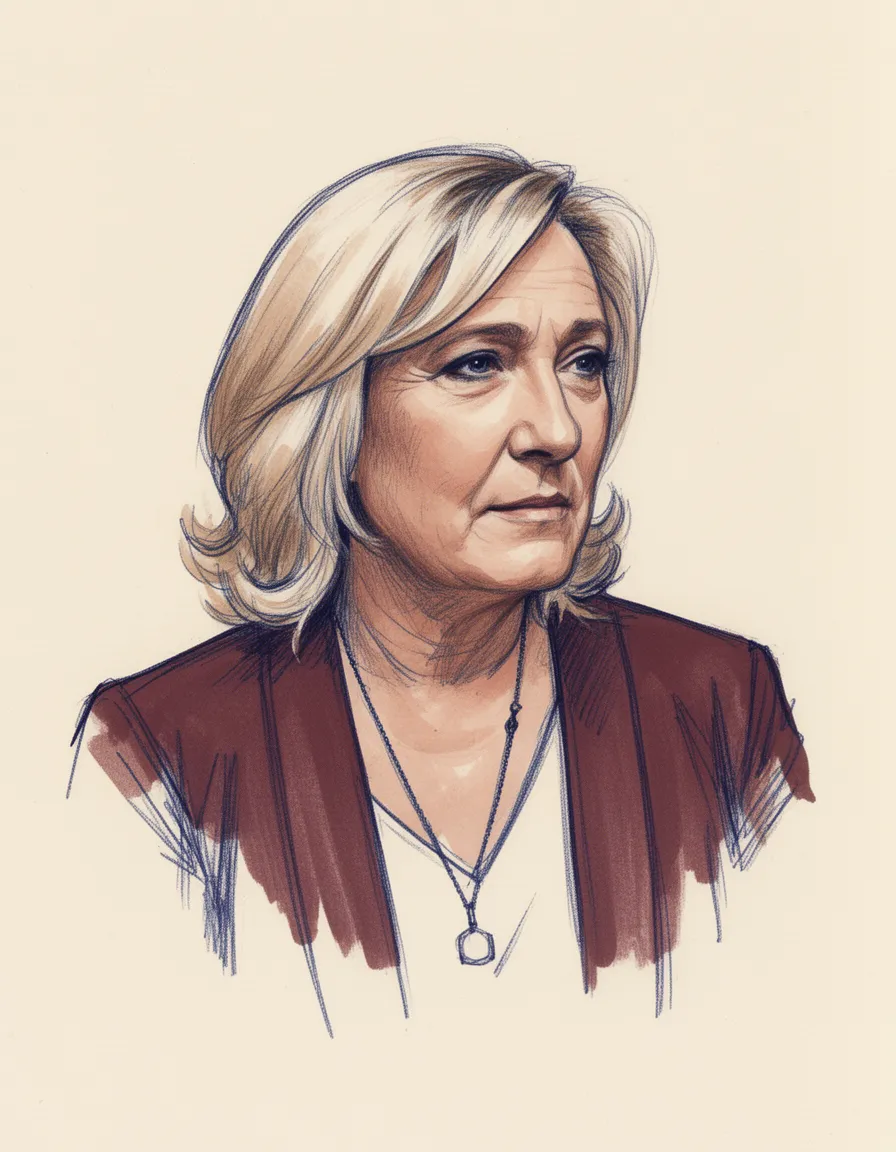
Marine Le Pen on Russia
Marine Le Pen's stance on Russia has shown an evolution, though she remains consistently focused on prioritizing French national interests and strategic autonomy in foreign policy.
Before the 2022 invasion, Le Pen consistently favored closer ties with Vladimir Putin's Russia, advocating for increased cooperation and often criticizing NATO and Western policy towards Moscow. This included securing a substantial loan for her party from a Russian bank to fund her 2017 presidential campaign.
After the full-scale invasion of Ukraine in 2022, she strongly condemned the military action, aligning more closely with the European consensus in that regard. However, she has reiterated that once the war is over, France should work towards reintegrating Russia as a strategic partner, suggesting a long-term view of renewed relations.
Timeline
- The National Front (FN), under Le Pen's leadership, borrowed €10.6 million from the First Czech-Russian Bank in Moscow.
- Le Pen met with Vladimir Putin during her second presidential campaign, signaling a desire for high-level engagement with Russian leadership.
- Reports indicated Le Pen no longer sought to leave the European Union or the Euro, shifting to a strategy of changing the EU from within alongside allied parties.
- In response to the 2022 Russian invasion of Ukraine, Le Pen strongly criticized Russia's actions but stated that Russia could become an 'ally of France again' if the war ends.
- Her 2022 presidential campaign was reportedly financed partly by a loan from the Hungarian bank MKB Bank, which required approval from Viktor Orbán, a close ally of Putin.
Actions Taken
- Diplomatic EngagementMet with Vladimir Putin, then President of Russia, during her second presidential campaign.
- Financial ActivityBorrowed €9 million from the First Czech-Russian Bank to fund the National Front's activities.
Criticism
Accused her of being overly favorable or subservient to the Kremlin, particularly highlighted by the Russian bank loan.
Sources5
- Made supportive comments of Vladimir Putin and Russia in the past, advocating closer cooperation before the 2022 Russian invasion of Ukraine; she strongly condemned the war in Ukraine, but stated Russia could become "an ally of France again" if it ends.
- Le Pen met with several incumbent heads of state including Lebanon's Michel Aoun, Chad's Idriss Déby, and Russia's Vladimir Putin.
- The FN had difficulty finding funding because of the refusal of French banks to provide credit. Instead, the FN borrowed €9 million from the First Czech-Russian Bank in Moscow in 2014, despite European Union sanctions placed on Russia following the annexation of Crimea.
- She has said she believes that Ukraine has been "subjugated" by the United States. She was strongly critical of NATO policy in the region, of Eastern European anti-Russian sentiment, and of threatened economic sanctions. In response to the 2022 invasion of Ukraine, Le Pen criticized Russia's action despite her previous pro-Russia stance.
- It was remarked that a Є10.6 million loan provided by the Hungarian bank MKB Bank chaired by Lőrinc Mészáros, a close ally of Viktor Orbán, was used to finance her presidential campaign.
* This is not an exhaustive list of sources.