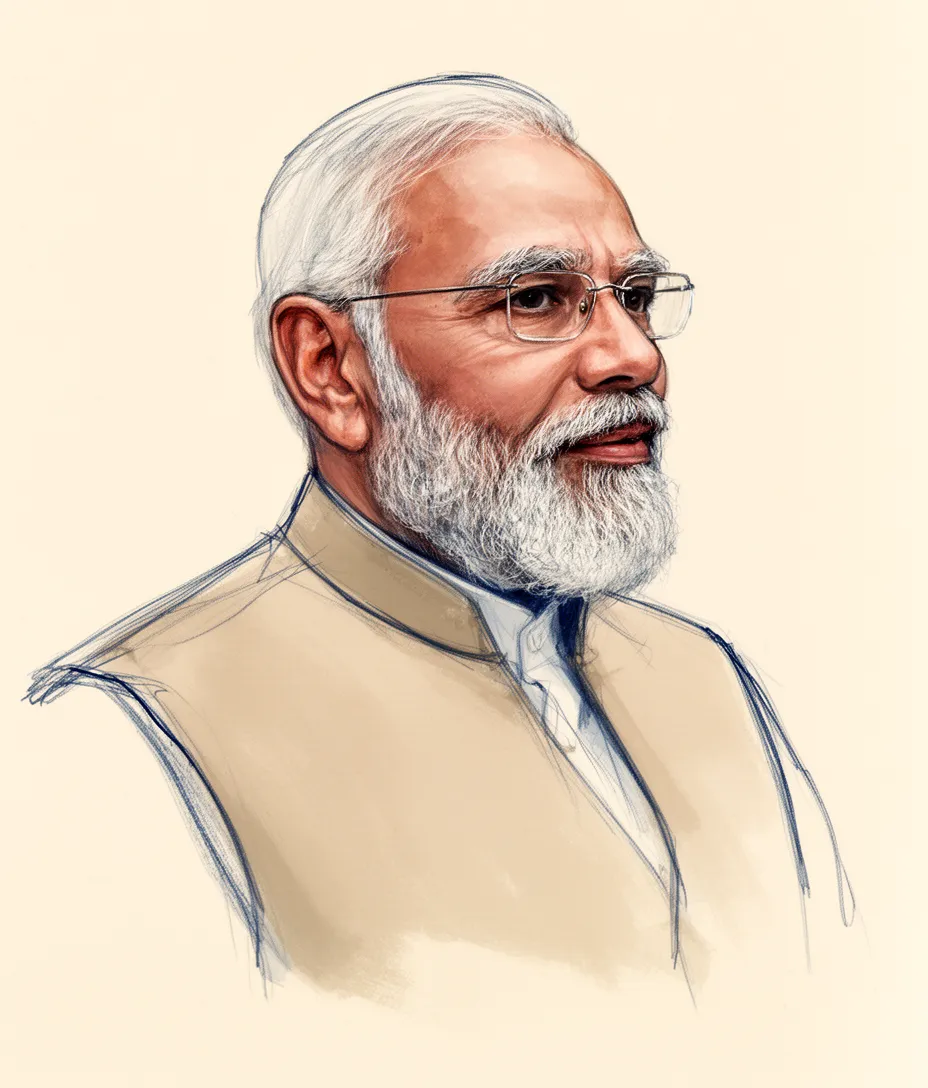
Narendra Modi on NRC (National Register of Citizens)
Narendra Modi's position on the National Register of Citizens (NRC) has seen a significant contradiction with key government figures, particularly in late 2019, amidst widespread protests against the related Citizenship Amendment Act (CAA). The Prime Minister publicly stated that since his government took office in 2014, there had been no discussion, not even of the word NRC, nationwide. However, his government later told the Supreme Court that the preparation of a nationwide NRC is a "necessary exercise" for any sovereign country to identify non-citizens.
Modi's stance in December 2019 was aimed at easing fears, especially among the Muslim community, who perceived the NRC as targeting them following the passage of the CAA. He explicitly denied that any plans for a nationwide NRC had been discussed and also denied the existence of detention centers, accusing the opposition of spreading lies. This public statement directly contrasted with prior statements by Home Minister Amit Shah, who had previously confirmed that an NRC would happen nationwide, and with the BJP's 2019 manifesto, which mentioned implementing the NRC in a phased manner across the country.
Despite his claims of no discussion, the Modi government later formally argued in an affidavit to the Supreme Court that an NRC is essential for identifying illegal migrants as per Indian law. This suggests a shift back to a formal government position that contrasts with Modi's rally statements, positioning the NRC as a legal and sovereign necessity rather than a policy choice being actively pursued by his office at that moment.
Context
Narendra Modi, as Prime Minister, heads the executive branch responsible for implementing nationwide policy, giving his stance on the National Register of Citizens (NRC) significant weight. The NRC is a process intended to create a list of legitimate Indian citizens, which has been a long-standing demand of the BJP and its ideological parent, the RSS.
The issue gained extreme prominence when linked with the Citizenship Amendment Act (CAA), which fast-tracks citizenship for non-Muslim religious minorities from specific neighbouring countries. Critics viewed the combination of CAA and a potential nationwide NRC as discriminatory against India's Muslim population, leading to massive nationwide protests.
Timeline
- Prime Minister Narendra Modi assured people in Assam that no genuine citizen would be left out of the NRC process there and expressed hope for the passage of the Citizenship (Amendment) Bill.
- Addressing a rally, Modi stated there had been no discussion on a nationwide NRC since his government came to power in 2014, blaming the Congress and others for spreading lies.
- Amid ongoing protests, Modi reiterated his denial of any nationwide NRC discussion and also claimed there were no detention centers, attempting to defuse protests against the CAA.
- The Modi government submitted an affidavit to the Supreme Court arguing that a national NRC is a 'necessary exercise' for any sovereign country to identify citizens from non-citizens.
Criticism
Modi's statement that there had been no discussion on NRC contradicted his own statement in the Lok Sabha that 'NRC will happen in this country'.
The contradictory statements caused confusion and were seen as an attempt to downplay the seriousness of the NRC linked to the CAA, which critics argue marginalizes Muslims.
Sources5
India's Modi contradicts key aide on NRC in bid to douse protests
* This is not an exhaustive list of sources.