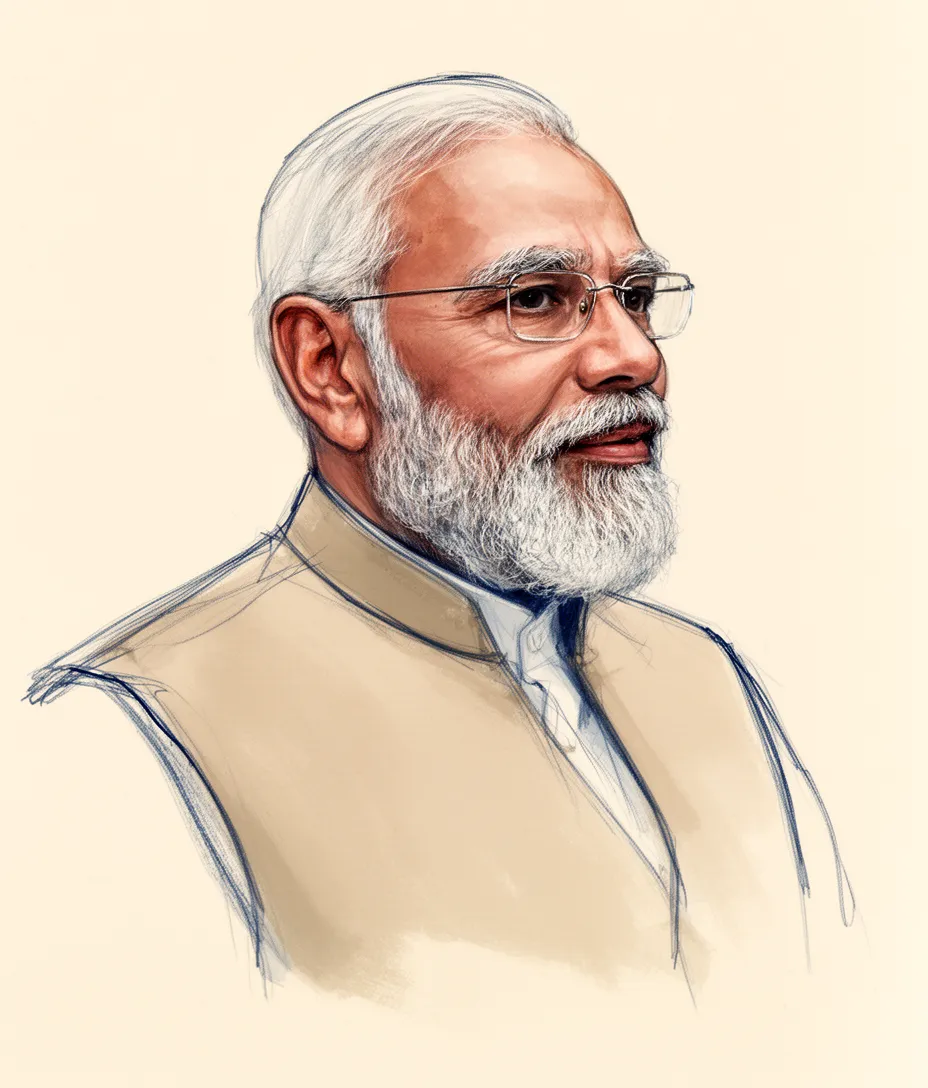
Narendra Modi on Rahul Gandhi
Narendra Modi views Rahul Gandhi as his principal political adversary, engaging in frequent, sharp critiques across various platforms. Modi often characterizes Rahul Gandhi's political rhetoric as immature, such as referring to his speeches as a "childish wail" or suggesting he "slept well and couldn't wake up" on time for parliamentary proceedings. This dismissive language is a consistent feature of Modi's commentary regarding the Congress leader.
During election campaigns, Narendra Modi intensifies his attacks on Rahul Gandhi, frequently linking him to the perceived failures of the past Congress governments and the Gandhi family legacy. Modi has accused four generations of the Gandhi family of undermining the Constitution through various amendments and actions, stating he will not allow them to change its fundamentals.
Furthermore, PM Modi directly counters Rahul Gandhi's specific claims, such as those regarding religious harmony, the NEET paper leaks, and national security incidents like the Galwan Valley clash. Modi has asserted that narratives falsely portraying Hindus as violent, put forth by Gandhi, will have long-lasting repercussions and has dismissed Gandhi's allegations as attempts to gain sympathy.
Context
Narendra Modi and Rahul Gandhi represent the central political contest in contemporary Indian national politics, pitting the ruling Bharatiya Janata Party (BJP) against the principal opposition party, the Indian National Congress (INC). Gandhi is widely seen as the leading face of the opposition against Modi's premiership.
This sustained rivalry shapes much of the national political discourse, with both leaders using public platforms to attack the other's credibility, political vision, and family history. For Modi, Rahul Gandhi often serves as a symbol of dynastic politics and what the BJP frames as the Congress party's 'Emergency mentality' and appeasement politics.
Timeline
- Narendra Modi's government criticized Rahul Gandhi for publicly tearing up a Cabinet ordinance brought by the Manmohan Singh government.
- Modi framed the 2024 election as a fight between those who worship 'Shakti' and those who want to destroy it, directly countering Rahul Gandhi's remark about fighting a 'Shakti'.
- Modi hit out at Rahul Gandhi for suggesting India would be 'set on fire' if the BJP won the general election, accusing Congress of provocation.
- Modi alleged that four generations of the Gandhi family, including Rahul Gandhi as a 'Shehzada', have destroyed the Constitution.
- Modi strongly responded to Rahul Gandhi's parliamentary remarks concerning the Hindu community, warning against narratives portraying Hindus as violent.
- Modi sharply criticized Rahul Gandhi's comments regarding the 2020 Galwan Valley clash, labeling them 'childish' and reckless for undermining national security.
Key Quotes
Jiske darshan hote hai uske pradarshan nahi hote hai" (the deity who is worshipped and sought, their depiction is not used to gain publicity).
Maybe they slept well and couldn't wake up (on time). For them it has been said, 'Ye keh keh ke hum dil ko behla rahe hain, wo ab chal chuke hain, wo ab aa rahe hain.'
The question that should be asked- who was the first to play with the Constitution? Pandit Nehru did. He brought the first amendment which was meant to restrict freedom of speech. His daughter (Indira Gandhi) then overturned the court verdict by bringing an amendment. Then her son (Rajiv Gandhi) came and overturned Shah Bano's verdict. He changed the Constitution.
a Shehzada came and publicly tore apart the cabinet decision.
Comparison
- Dynastic Politics: Modi consistently contrasts his own rise as a grassroots politician with the Congress leadership, often referring to Rahul Gandhi and other opposition leaders as 'shehzadas' (princes) who represent 'parivarvad' (dynastic politics).
- Constitutional Integrity: Modi contrasts the BJP's perceived reverence for the Constitution with actions taken by Jawaharlal Nehru, Indira Gandhi, and Rajiv Gandhi, positioning himself as the protector against the Gandhi family's perceived historical tampering.
- National Security: Modi counters Gandhi's claims on issues like the Galwan Valley clash by asserting that Gandhi's remarks undermine the armed forces, contrasting this with the BJP's commitment to defense reforms.
Sources8
PM Modi Responds Strongly to Rahul Gandhi, Criticizes Narrative on Hindu Community |Lok Sabha Speech
* This is not an exhaustive list of sources.