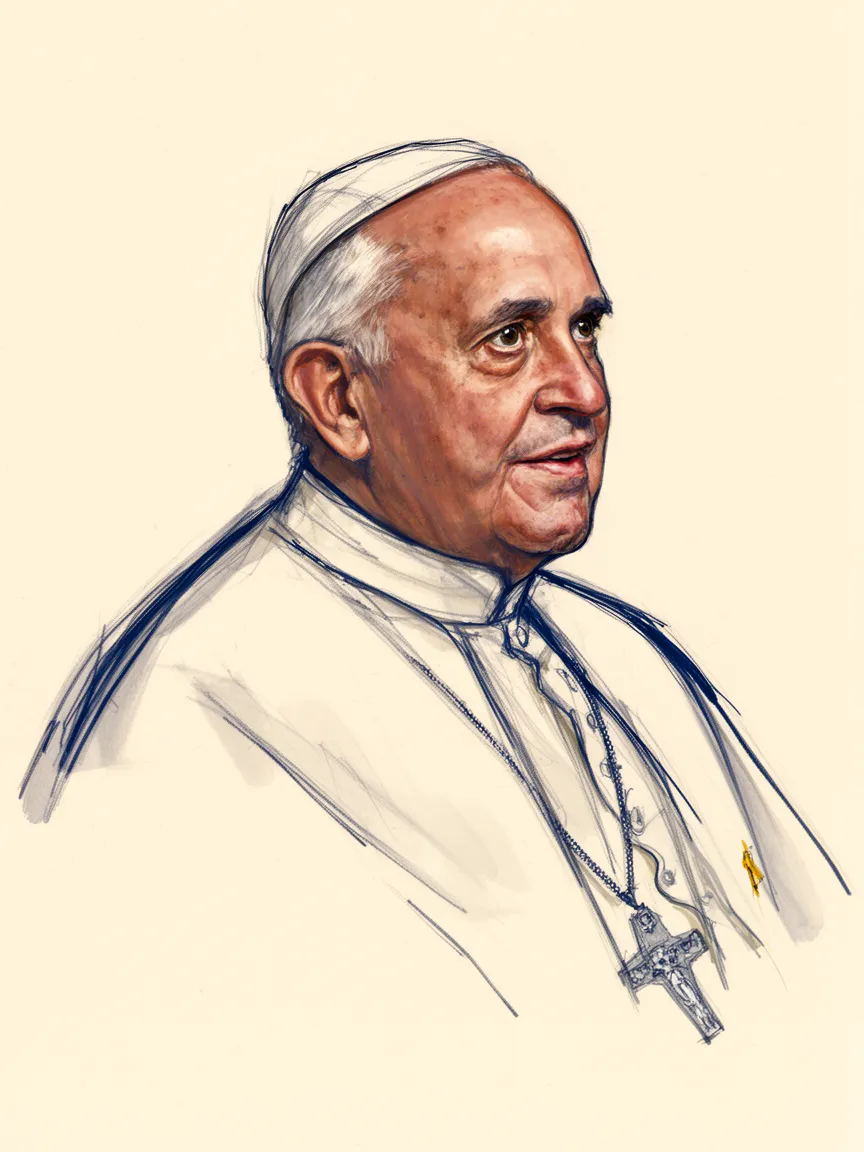
Pope Francis on Climate Change and Ecology
Pope Francis expresses a strong conviction that climate change is real and that it is mainly a consequence of human activity. He explicitly stated this position in his landmark 2015 encyclical, Laudato Si’, declaring the problem urgent and warning against the consequences of continued inaction for future generations.
Central to his thinking is the principle of integral ecology, which mandates that the environmental crisis cannot be separated from issues of social injustice. He repeatedly calls for hearing "the cry of the earth and the cry of the poor," emphasizing that ecological degradation and human suffering are two dimensions of the same complex crisis.
Consequently, Pope Francis urges a decisive action, here and now, from all people and world leaders to stop environmental ruin. This involves advocating for systemic changes in development, consumption, and politics, alongside a profound interior and cultural conversion toward simplicity, responsibility, and care for creation.
Context
Pope Francis’s focus on ecology is deeply rooted in his chosen name, Francis of Assisi, who is the patron saint of ecology. This choice immediately set a tone for his papacy, signalling a commitment to caring for the natural world.
His encyclical, Laudato Si', is a significant part of Catholic Social Teaching, but it is novel because it is the first social encyclical addressed to all people, not just Catholics, framing the crisis as a global dialogue.
His emphasis is on integral ecology, meaning that economic, social, and environmental issues are interconnected, demanding solutions that uplift the marginalized alongside protecting the planet.
Timeline
- Pope Francis began his pontificate, choosing his name in honor of St. Francis of Assisi, the patron saint of ecology, symbolically signaling an early focus on caring for creation.
- Published the encyclical Laudato Si': On Care for Our Common Home, which is the first papal document dedicated entirely to the environment, squarely backing scientists who identify human activity as the main driver of global warming.
- The encyclical called for leaders to hear the “cry of the earth and the cry of the poor” and urged a change in lifestyle away from consumerism, ahead of the UN climate change conference in Paris.
- The Pope stressed the importance of political consensus in addressing climate change, highlighting the need for leaders to enact necessary policies.
- The Vatican newspaper established a new environmental column, For the Care of our Common Home, to provide ethical reflection and practical solutions alongside calls for institutional action.
Actions Taken
- Official StatementPublished the encyclical Laudato Si': On Care for Our Common Home, a comprehensive document detailing the Church's teaching on environmental degradation, consumerism, and climate change.
- Call To ActionCalled on the world's 1.2 billion Catholics to join the fight against climate change, viewing it as a moral imperative.
- Institutional EngagementThe Vatican engaged directly in the fight against climate change, with the Pope dedicating much of his papacy to raising awareness.
- Communication StrategyThe Vatican newspaper began a weekly environmental section, For the Care of our Common Home, to discuss ethical reflection and practical solutions.
Key Quotes
Never have we so hurt and mistreated our common home as we have in the last two hundred years.”
Reducing greenhouse gases requires honesty, courage and responsibility.”
The entire material universe speaks of God's love, his boundless affection for us. Soil, water, mountains – everything is, as it were, a caress of God.”
Doomsday predictions can no longer be met with irony or disdain. We may well be leaving to coming generations debris, desolation and filth,”
Criticism
Some conservatives scolded Pope Francis for delving into science and politics with the encyclical, with one expressing concern it would be used to advocate for regressive tax increases.
Sources7
Pope Francis Encyclical And Climate Change
* This is not an exhaustive list of sources.