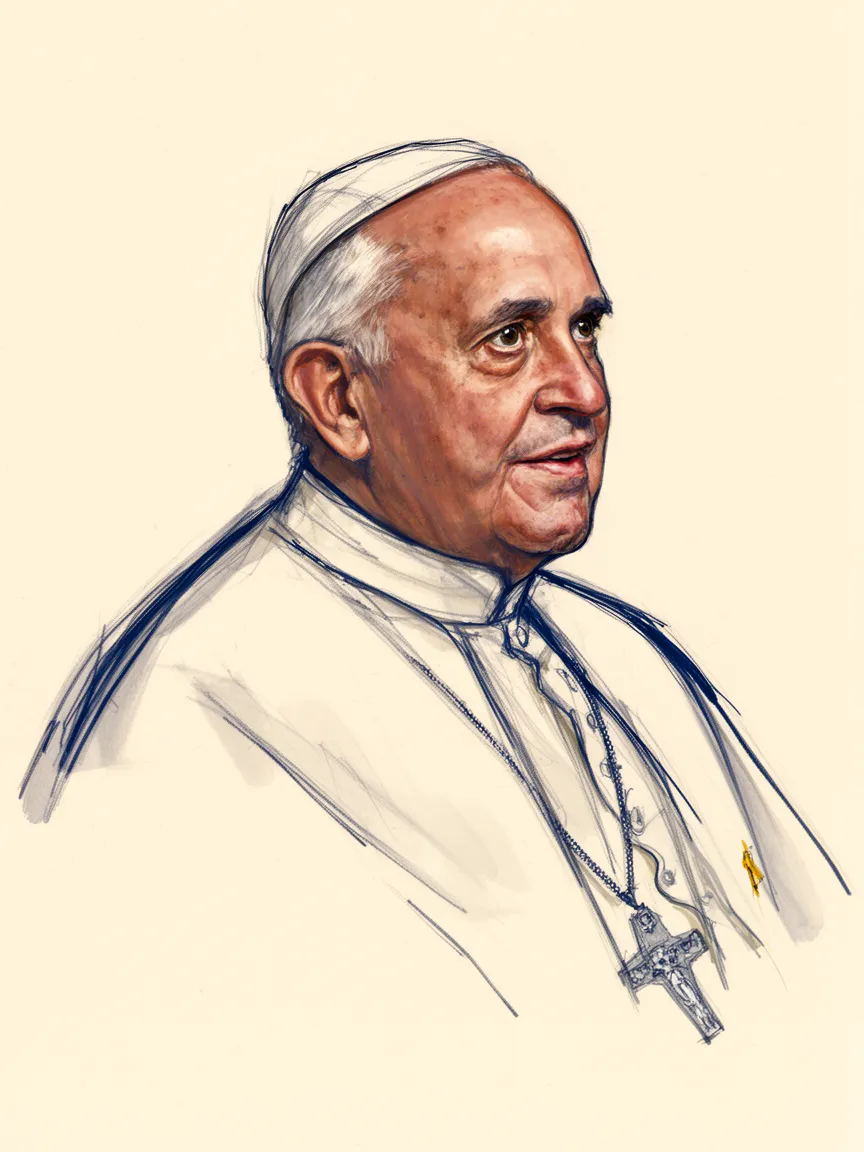
Pope Francis on Gaza Conflict
Pope Francis's position on the Gaza Conflict has been characterized by repeated and increasingly forceful calls for peace, humanitarian access, and an end to the violence affecting civilians.
From the initial escalation, he urged for ceasefires, the release of all captives held by Hamas, and the urgent need to allow humanitarian aid into the Gaza Strip to alleviate what he termed a “very serious and deplorable humanitarian situation.”
While consistently emphasizing that "War is always a defeat!," Pope Francis also demonstrated nuance by condemning the Hamas massacre on October 7, 2023, while simultaneously becoming more outspoken in his criticism of Israel's subsequent military campaign, even suggesting an investigation into whether it constituted genocide.
Context
Pope Francis, as the Pontiff and head of the Holy See, wields significant global moral authority, making his statements on international conflicts highly influential beyond the Catholic community.
His position on the Gaza Conflict is noted as a break from the Vatican's traditionally cautious stance on the Israel-Palestine conflict, aligning instead with his broader reformist papacy focused on social justice and compassion for the suffering, particularly civilians.
Timeline
- Expressed tears and apprehension over the situation, praying for families, and called for the immediate release of hostages.
- Called for a ceasefire in Gaza, urging for humanitarian aid entry and the freedom of all captives.
- Expressed sorrow over the resumption of Israeli attacks after a temporary truce, warning of renewed destruction.
- Suggested that international experts indicated what was happening in Gaza had the characteristics of genocide, prompting criticism from Israeli officials.
- Reiterated a strong call for an "immediate ceasefire in Gaza," asking all parties to stop the hostilities.
- Condemned the killing of aid workers by Israel and again called for an immediate ceasefire.
- Called the humanitarian crisis in Gaza "very serious and shameful" and stated that bombing civilians, especially children freezing due to destroyed infrastructure, is unacceptable.
Actions Taken
- Pastoral outreachMaintained nearly nightly contact, often via video calls, with the Christian community sheltering at the Holy Family Church in Gaza, offering comfort.
- Symbolic gesturePlaced baby Jesus in his Christmas Nativity scene wrapped in a keffiyeh, a central symbol of Palestinians and anti-Israel protests.
- Ecclesiastical appointmentAppointed the first cardinal of Palestinian origin to the College of Cardinals during his mandate, a significant gesture recognizing Palestinian Christians.
Key Quotes
War is always a defeat! Every war is a defeat!
Yesterday children were bombed. This is cruelty. This is not war.
We cannot in any way accept the bombing of civilians... We cannot accept that children are freezing to death because hospitals have been destroyed or a country's energy network has been hit.
I appeal to the warring parties: call a ceasefire, release the hostages and come to the aid of a starving people that aspires to a future of peace!
Criticism
Sharply criticized the Pope's suggestion that Israel's campaign might constitute genocide, calling the remark a 'trivialization' of the term genocide.
Accused the pontiff of antisemitism following his suggestion that the global community should study the potential for genocide in Gaza.
Argued that the Pope's language—referring to the situation as a 'conflict' rather than 'genocide' and calling parties 'warring'—did not adequately reflect the horrors or the unequal power dynamic.
Sources6
Pope Francis calls situation in Gaza 'shameful' as he steps up criticism of Israel's offensive
* This is not an exhaustive list of sources.